The Worlds Most Dangerous Placejames Fergusson Book Review
by Joseph Hammond Fergusson'southward work on Afghanistan is highly regarded, even if some of his conclusions (such as the suggestion that ISAF should negotiate with the Taliban) were considered controversial. Fergusson applies a similar on the basis approach to his latest book, but the subject this time is the Horn of Africa and non Primal Asia. In compiling the book Fergusson travelled across "Greater Somalia" from Hargeisa in the due north to the Somali bulk areas of Kenya in the south. When Somalia first made global headlines later the finish of the Cold War, most of al-Shabaab were still in theirs diapers. Betwixt 1992 and 1995, Somalia was habitation to the United Nation's largest international mission, UNOSOM. UNOSOM'south staff of 30,000 consumed an annual upkeep of $ane.5 billion. The international customs seemed committed to stabilising Somalia in the spirit of pan-humanism that briefly characterized the Post-Common cold War flow. Then the fateful 1993 Battle of Mogadishu occurred, all-time chronicled in Mark Bowden's 1999 bookBlack Hawk Down, and in its aftermath the international community decided that stabilizing Somalia wasn't worth the price. It wasn't until the rise of the Islamic Courts Spousal relationship in 2007 that Somalia again captured headlines across the world. The country's status on the fringe of global news is superficially similar to Afghanistan (not to mention its tribal politics), which is perhaps why Fergusson decided to make Somalia his next project after extensive reporting in Transitional islamic state of afghanistan. The "dangerous" referred to in the championship might be the outcome of the fact that this region has been awash in pocket-size artillery for decades. Modern rifles were first introduced to the area by the French in large numbers during the edifice of the Addis-Abba-Djibouti railway, assuasive homicidal inter-tribal warfare to become genocidal (page 55). During Globe War I, the Ottomans provided guns to Somalis willing to fight the British. Following Globe State of war Ii, with Ethiopia in ruins and British or Allied command of what is today Kenya, Somalia, and Djibouti, at that place was for a cursory moment an opportunity to create a true nation country. Nevertheless the vision of a Greater Somali alluded to by the five-pointed star on Somalia'southward national flag was not realized. Globe War Two and the Cold War brought even more Western arms to the region. This point is persuasive because few regions in Africa were every bit much of a geopolitical playground in the 20th century as the Greater Somali region was and the primary beneficiary of this since the end of the Cold War has been Ethiopia. Indeed, the destruction of Somalia was achieved for similar geopolitical reasons as that of Ethiopia, every bit Somalia once fielded Africa'due south most capable army (page 113). This is one of the more readable journalistic books on an African security problem in part considering of Fergusson'south dedication to understanding Somali culture (he clearly studied Somali music and poetry in writing the volume). At that place is besides plenty of British majestic history, with references to the Mad Mullah, Sir Francis Burton, and Gerald Hanley. Fergusson talks to Muslim sheikhs, the unemployed, those printing-ganged into al-Shabaab and those merely trying to make ends run into. The author also travels outside of Somalia for his research, including Somali-bulk areas in Kenya and Federal democratic republic of ethiopia and the wider diaspora in the Great britain and The states. Probably the nigh intriguing part of the volume is the time Fergusson spends in Mogadishu where he meets former al-Shabaab fighters and past chance spends some time with Jerry Rawlings, the half-Scottish erstwhile President of Ghana. He likewise spends time with frontline Ugandan units battling al-Shabaab in Mogadishu. The discussions with Ugandan military machine commanders deployed to Somalia are enlightening, though the author seems to experience that Ugandan President Museveni was primarily concerned with regional security when he sent Ugandan troops to Mogadishu. Yet the inverse was true in 2006 when the decision was made for African Matrimony troops to intervene in Somalia and today the Ugandan military believe al-Shabaab is supporting anti-Museveni groups like the ADF. In the Horn of Africa, as in Transitional islamic state of afghanistan, all is oft not as information technology first appears.
Sun, March 03, 2019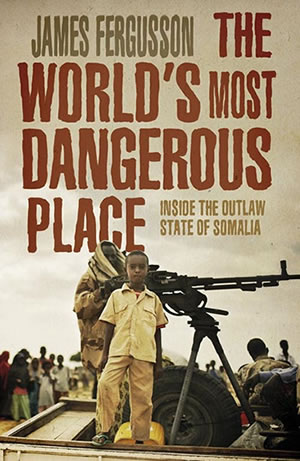
The Worlds Almost Dangerous Place: Inside the Outlaw State of Somalia
Past James Fergusson
Da Capo Press, 432 pages, $27.50 (hardcover)
reinholdtanderies.blogspot.com
Source: https://hiiraan.com/op4/2019/mar/162541/book_review_the_worlds_most_dangerous_place_inside_the_outlaw_state_of_somalia.aspx
0 Response to "The Worlds Most Dangerous Placejames Fergusson Book Review"
Postar um comentário